


Best UI UX Design Course in Hyderabad
The Science of Smarter Digital Experiences
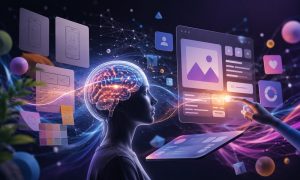
Think of opening two mobile applications which provide the same functionality. One of the applications is easy and smooth to navigate through, whereas another application looks confusing, difficult and even mentally tiring to use. Best UI UX Design Course in Hyderabad Even though the functionalities of both of the applications can be the same, your brain will respond to them in completely different ways. This is what makes up the basics of NeuroUX – a relatively new multi-disciplinary science which combines the fields of neuroscience, cognitive psychology, Human Computer Interaction (HCI) and artificial intelligence to create digital products that comply with the natural functioning of the human brain.
In the last ten years, neuroscience has expanded its boundaries from a medical lab to a product design lab helping global technology firms to build websites, mobile apps, enterprise software, healthcare systems and AI solutions based on scientific evidence on attention, memory, emotions, perception and decision making rather than creativity or visual fashion. Best UI UX Design Course in Hyderabad As more and more businesses are making use of research-oriented product development.
Introduction to NeuroUX: Where Neuroscience Meets Interface Design
The term ‘neuro UX’ is used to refer to the implementation of neuroscience principles in the designing of interfaces and products. Instead of just asking users for their preferences, in neuro UX, researchers study the reaction of the brain and the body while interacting with digital interfaces. Eye tracking, EEGs, fMRI, galvanic skin response (GSR) and biometric measurement are some techniques through which researchers can identify where users get stuck, what attracts their attention, and where cognitive load occurs.
Usability testing is done using interviews, questionnaires and observation. However, the contribution of neuroscience makes us learn things which the users themselves cannot put into words. This has been making Neuro UX an important field in Human Computer Interaction studies.
Students enrolling in the best UI UX design course in Hyderabad must know that the decisions made in the modern UX field are more evidence-based. While AI can work with big data, human emotions, motivations and context cannot be interpreted without designers.
Why the Human Brain Is Fond of Simplicity
The human brain constantly processes vast amounts of information. Any unnecessary animations, confusing navigation menu, badly positioned button, or inconsistent layout requires mental processing power. In cognitive psychology, this phenomenon is called the cognitive load, the number of mental resources that must be expended to perform an action.
Many studies prove that interfaces with a lower cognitive load result in faster performance of tasks by users, fewer errors, and increased satisfaction from use. Designers try to reduce unnecessary choices, organize information in clusters, and create a clear visual hierarchy.
So, when a banking app shows only relevant actions on its home page, users will find the necessary feature quicker than when they have to choose among dozens of options. The same applies to personalization based on artificial intelligence: it decreases the cognitive load but preserves transparency and user choice.
It becomes increasingly useful knowledge for the students who attend the best UI UX design course in Hyderabad since now the employers require designers to back up their design decisions by scientific research.
Eye Tracking: Uncovering Areas Where Users Actually Look
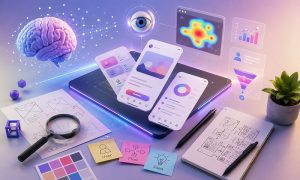
One of the most prominent approaches of NeuroUX is eye tracking studies. Eye trackers show where a user looks at, how long he or she observes interface elements, and in what sequence visual information is processed. The heat maps created during eye tracking experiments often prove that users do not see large areas of an interface, while focusing their attention on specific navigation elements, calls to action or distracting visuals.
From a designer’s point of view, this means that buttons can be easily seen when placed inside natural scanning sequences, while important information located in accordance with reading rules will help to shorten search time. Meanwhile, any distracting design will only divert users’ attention from performing necessary actions.
With the help of Artificial Intelligence, it becomes possible to identify behavioral patterns among thousands of participants in eye tracking experiments. This allows for faster layout optimization compared to conventional eye-tracking analysis. However, understanding users’ behavior requires a special approach, which can only be provided by professionals trained in research methods of UI/UX.
Working Memory, Attention, and Decision Making in Interface Design
The neuroscience of human beings shows us that our working memory is limited. We can not process large volumes of information, such as instruction list, complex forms, and multiple navigation choices at once. So, good designs gradually provide us with information through progressive disclosure and grouping.
Our attention is also limited. Notifications, animations, ads, other interface elements constantly battle for our attention. Thus, we need to be cautious in deciding what needs to be highlighted and what is secondary.
The Artificial Intelligence helps us to customize interfaces according to our actions. Personalized dashboards, intelligent suggestions, context-sensitive navigation make us face less complexity and do our tasks easier. But AI should assist us in our decisions and not control our behavior. That is why ethical design becomes an integral part of UI/UX design in the future.
That is one of the reasons why people, who search for the best UI UX design course in Hyderabad, now find it helpful to learn about cognitive science, AI, and product design rather than only software.
The Science Behind Each Click: Fitts’ Law & the Importance of Little Design Choices
One of the most important principles of HCI was introduced by psychologist Paul Fitts way back in 1954. Despite the fact that it was formulated well before the emergence of smartphones and web applications, Fitts’ Law continues to be one of the most scientifically-backed principles of UI/UX design. Companies like Google, Apple, Microsoft, and Adobe use this principle in designing the interfaces of their applications for millions of users.
According to Fitts’ Law, the time taken to reach a certain target is affected by two variables: the size of the target and its distance to the point where people interact with it. Simply put, larger buttons placed at short distances from the areas of natural interaction are easier to click compared to small elements placed farther away.
That’s why the mobile apps feature large buttons for frequently used actions such as “Pay Now,” “Add to Cart,” or “Send.” If the buttons are small or placed too far, people get frustrated trying to find and click them; they commit more mistakes and usually give up the task.
Gestalt Psychology: How Brain Processes Visual Perception in Relation to UI/UX Design
Perhaps one of the most interesting and exciting contributions of psychology to the realm of UI/UX design is offered by the Gestalt Theory which deals with the natural way of perceiving visual relations. Unlike breaking down an image into its component elements, the brain naturally tends to see objects as groups forming meaningful whole.
The following are some of the gestalt principles used in designing intuitive interfaces:
- Proximity: Items located near each other look like related.
- Similarity: Objects that have similar color, shape or typography look alike.
- Continuity: User follows natural continuity while viewing a visual element.
- Closure: Users subconsciously complete the incomplete images.
- Figure-Ground: It is important to make important information visible.
Artificial Intelligence now assists in assessing the consistency of visual elements within large design systems and automatically detecting such things as improper spacing, misalignment and accessibility issues. Nonetheless, the assessment of how visual relations affect the perception of the user still requires human involvement.
Knowledge of the above-mentioned psychological principles allows students to build an interface that conveys the information about the structure without any explanation.
The Basics of Neuroeconomics: Reasons Behind Digital Decisions
Each click, each purchase, each subscription, each filling of forms is the result of a decision which is made by a human brain. If previously, traditional research of UI/UX observed users’ behavior via interviews and usability tests, the interdisciplinary area of Neuroeconomics which includes neurology, psychology, and economics tries to understand why people make certain decisions in the context of digital interaction.
Neuroeconomics studies the reasons of making decisions, such as emotional state of the user, his perception of the risks, expectations of reward, his trust, and memory. Researches have already revealed that users seldomly make strictly logical decisions. They rather use various cognitive tricks and emotional states, their previous experience. For UI/UX designers, it means that understanding human behavior is as essential as knowing design tools.
For instance, the ease of use and transparent pricing of the check-out page makes users buy things more often. On the other hand, additional hidden costs, complicated navigation, and unexpected pop-up windows may confuse users and decrease their trust. Now, there are various ways of detecting those obstacles thanks to AI-driven analytics and studying user paths, abandoned sessions, and behaviors.
Eye-Tracking Heatmaps: How AI Reveals User Attention
One of the most rapidly developing fields of Human-Computer Interaction research is eye tracking. Instead of asking users where they were looking at on the webpage or the mobile app, eye tracking technology actually captures users’ gazes in real-time. As a result, heat maps are created that show what interface elements users pay attention to, which elements are overlooked by them and where users pause.
Recent developments in Artificial Intelligence allowed making this analysis more efficient since machine learning algorithms analyze thousands of user sessions, recognize repeated patterns of user attention and predict the zones of confusion much faster than human analysis.
There are several ways in which research results can be applied by designers:
- Improvement of primary buttons’ placement.
- Decrease of visual distractions.
- Improvement of reading flow.
- Improvement of the information hierarchy.
- Increase of conversion rate.
- Improvement of accessibility for various groups of users.
For example, if AI recognizes that users tend to ignore important “Register” button because it looks like a part of the background, designers can change the color, size or position of the button based on the obtained data, not based on assumptions.
Affective Computing: Designing Interfaces That Understand Human Emotions
- Another area of research that UI/UX designers should know about is Affective Computing, or emotion-aware computing. This is an area where systems will be created that recognize, understand, and react to human emotions by facial expressions, voice tone, typing, physiological data, and interaction.
- With the development of new AI features, there is now the beginning of personalization of digital products not only based on user preferences but also their emotions. For instance:
- Educational platforms will provide more support when users experience difficulties with learning some topic.
- Mental well-being apps will adjust interactions and will help users to relax and reduce stress.
- Customer support tools will have to give more empathic responses if they identify any signs of frustration.
- Health care websites will show more caution when providing users with information.
- The most important thing to remember about such innovations is that they have to comply with user privacy, have their informed consent and not use manipulation in their design.
- When students enroll in the best UI UX design course in Hyderabad, they need to be acquainted with such innovations because they will soon become the next level of intelligent digital products. At Cloud Vision Technologies, we encourage our learners
Explainable AI (XAI): Building Trust Using Transparent Design
With the increasing integration of Artificial Intelligence in digital products, the user is forced to use systems capable of giving recommendations, predictions, or taking automated actions. But when AI technology acts like a ‘black box’, it can be difficult for the user to trust the output of AI systems.
To address this problem, Explainable AI (XAI) emerges as an important and increasingly popular research field. Unlike traditional ‘black box’ AI, Explainable AI aims at being transparent in terms of decisions that AI systems take.
Examples of Explainable AI include:
- Explanation of why this product is recommended.
- Explanation of why the loan application has been granted such a decision.
- Explanation of why this navigation route was chosen.
- Explanation of why particular educational content is recommended.
For UX designers, explanation of AI decisions becomes an important task as poorly communicated explanations of AI outputs might confuse the users. Good explanation increases the user’s confidence and makes them trust the system.
Dark Patterns: The Importance Of Ethical UX Today
Not all interfaces are designed with the user’s welfare in mind. There are interfaces that deliberately implement dark patterns, meaning design techniques that coerce users into performing actions they normally would not.
Some of these include:
- Subscription cancellation that is hard to locate.
- Pre-checked consent for marketing purposes.
- Faux timers.
- Complicated privacy settings.
- Hard-to-find account deletion.
- Manipulative purchase confirmations.
These are some of the things that are coming under attack due to recent research and regulatory discussions. Dark patterns are being criticized as they are designed to favor businesses’ short-term profits over their customers’ best interest.
The introduction of artificial intelligence comes with its own set of ethical issues, including bias and personalized manipulation. Designers thus need to take up the responsibility of making sure their AI designs do not violate users’ rights in any way.
Learners enrolling in UI UX design courses in Hyderabad need to be knowledgeable about ethical design as much as visual design today. This is what Cloud Vision Technologies encourages.
Conclusion
The future of UI/UX Design is going to be dominated by people who are able to mix creativity, research and Artificial Intelligence. Terms like NeuroUX, Fitts’ Law, Hick’s Law, eye tracking, explainable AI, affective computing, ethical UX, and accessibility are no longer just concepts written in research articles; they are increasingly becoming criteria for the success of digital products.
When it comes to choosing the best UI UX Design course in Hyderabad, it should not only focus on software modules and duration of the course. The future-proofed course should give learners knowledge and experience of research in Human-Computer Interaction, AI-assisted design, cognitive psychology, accessibility guidelines, and ethical product development.
Cloud Vision Technologies wants to ensure that learners get all these skills through this training course.
Why should designers be concerned about AI when it comes to UI/UX?
Artificial Intelligence allows designers to analyze users’ behavior, create prototypes, enhance accessibility, perform routine tasks and conduct research. Human creativity, empathy and ethics still play a vital role,
Why is accessibility important in UI/UX?
Accessible interface allows different kinds of users to use digital products easily. Moreover, accessibility also means that you can make your product more usable for a wider range of people
. Which tools are commonly taught in the best UI UX design course in Hyderabad?
A comprehensive course typically covers tools such as Figma, FigJam, Adobe XD (where applicable), Miro, AI-powered design tools, and prototyping platforms used by professional design teams.